Newshound: OTAs lead in US, changing distribution strategies, traveler’s path to purchase


OTAs remain the top research source for US vacation package buyers, says Expedia

Online travel agencies continue to be American consumers’ favorite source of information prior to booking vacation packages, despite all the buzz about review sites such as TripAdvisor and metasearch sites such as Kayak.
http://www.tnooz.com/2013/08/26/news/otas-remain-the-top-research-source-for-us-vacation-package-buyers-says-expedia/


RM hits the big stage but must work harder to secure the lead role

Revenue management today is beginning to deliver strategic benefits across the business. With a bigger and broader mandate, RM specialists have an important role to play in communicating with other departments to make the most of emerging opportunities.
http://www.eyefortravel.com/revenue-and-data-management/rm-hits-big-stage-must-work-harder-secure-lead-role

Revenue managers adapt distribution strategies

While new distribution channels are emerging seemingly every day, more accurate forecasting and improved technical automation are helping hotel revenue managers stay sane. Few hotels, unless they’re large full-service properties with a significant amount of meeting space, have a dedicated manager assigned to only that property, sources said. Many hotels share a revenue manager with a small group of properties and, in most cases, a general manager also acts as the revenue manager.
http://hotelnewsnow.com/Article/11094/Revenue-managers-adapt-distribution-strategies

The Traveller’s Path to purchase

When it comes to leisure travel shopping, consumers spend a significant amount of time online researching options. Up to 45 days leading up to a booking, a consumer will conduct as many as 38 visits to travel sites. Knowing how and when to influence their decision-making process is crucial to generating mindshare and ultimately driving bookings. In this report by Expedia Media Solutions, get a snapshot of how the overall purchase path looks like from initial exploration through the booking stage.
http://cdn2.hubspot.net/hub/149354/file-271132325-pdf/docs/Path_to_Purchase_Expedia_Media_Solutions_MillwardBrown.pdf

Spanish hotel major – H10 selects eRevMax to optimize online sales potential

H10 Hotels, one of the largest hotel groups in Spain, has selected eRevMax to increase their online business and distribution exposure. “RateTiger has really helped us to save time and respond to market dynamics. It is faster than any other channel manager when it comes to updating rates.” said Meri Ferrando, Sales Manager, H10 Urquinaona Plaza.


Real time connectivity is directly impacting on H10’s sales, maximising take up on last minute availability to enhance profits from this operational area. Two new properties of H10 Group,
Urquinaona Plaza and Port Vell hotels have been using RateTiger Channel Manager to centrally manage rates and availability in real-time across all connected channels. The properties are also utilizing the eRevMax Channel Eco-system, which offers two-way seamless connectivity with global OTAs to reach out to new markets.

Read the full story here.

Hotel channel management leader revamps Enterprise Connectivity Platform

eRevMax International today announced the launch of a new website focused on ‘Connect by eRevMax,’ its enterprise connectivity solution focused on providing hotel companies with a centralized distribution solution. “Connect’s rebranding represents our evolution and strategic direction,” said Greg Berman, Chief Operations Officer, eRevMax International. “We are making key, targeted moves as we align product in support of our customer-centric business strategy.”

Connect, formerly known as RTConnect, the electronic distribution XML gateway for the hospitality industry, provides connectivity for rate and inventory distribution, and reservation delivery to existing hotel management systems. It enables hotel chains to centralize their distribution strategy by managing sales channels for all its properties in real-time directly from PMS / CRS through the web-based Connect Control Center.
The launch of the Connect website will provide a new visual identity – www.erevconnect.com, giving customers all the information about product features, benefits and latest updates.

Click here for the full story.

Adjusting to the Demands of Connected Customers: It’s All About Speed

The distribution landscape has changed rapidly in the last five years with the emergence of mobile as an important e-commerce channel. The advent of iOS and Android has changed the consumer behavior, and shortened the travel booking window. The popularity of same-day booking channels like HotelsTonight.com along with the dominance of traditional OTAs have thrown a major challenge for today’s revenue managers – i.e. how to stay in tune with the booking dynamics of each channel.

The opportunity that comes with the divergence of online distribution channels has also led to an increasing dilemma for hoteliers – how to manage channels profitably and accurately with limited resources. Throwing manpower at the issue is no longer an option. One small mistake and a hotel can face huge revenue losses as well as a downgraded ranking and a penalty from their distributors!

Facing a search-savvy customer, who will on average search 22 travel sites before booking, hotels have to stay visible at every touch point; and this is where superior connectivity becomes essential. In today’s multi-channel environment, keeping up-to-date with the distribution mix manually is not a daunting task, it’s virtually impossible! 

Understanding the role of social search
Over time, the growing power of web interaction, social media and mobile has changed the consumer’s shopping behavior, and hoteliers need to address them by taking advantage of technology to integrate social media into the distribution architecture. According to Expedia, hotels that scored one point higher in the guest popularity rankings were able to command a 9% higher average daily rate on Expedia. Several other studies have also pointed to the impact of user-generated content in the form of guest reviews as drivers of hotel rate and revenue. 

With Google, Bing and other search engines giving importance to social search, customer profiling has become important. Google has been making suggestions based on previous search and purchases for a while now. Major OTAs like Expedia, Orbitz and Booking.com have followed suite. This is where understanding the consumer becomes crucial. The more the revenue manager knows about the price sensitivity of a particular segment, the more he or she is able to price optimally. Social media provides hotels with vital inputs to map the customer’s state of mind and hence elasticity. Rate benchmarking tools help hotels to track the market dynamics and rate movements. Revenue managers also get an overview of how rates are positioned on different OTAs compared to their competitors for different dates on different channels. Knowledge of rate behavior along with price elasticity is the key to optimal pricing.

In the last couple of years, m-commerce has grown exponentially, and has the potential to contribute up to 20% of bookings through hotel-owned channels, according to PhoCusWright. For hotels, it not only means another channel to manage, but a channel to push the last available inventory. How fast you can react to the changing situation will have a direct impact on the revenue! But that can only be done if you are selling the right product to the right person for the right price on the right channel. Hence, it is important to understand consumer behavior and listen to what they are saying and address their concerns.

Future rate data provides revenue managers with the business intelligence important to creating rate strategy with the target to constantly increase product position and price and thus revenue. With prices set in sync with rate behavior, hoteliers have more confidence to manage last minute availability. This rate manipulation both for today and for tomorrow helps the revenue managers to begin improving the value of their product and its price. 

What is Enterprise Connectivity and why is it gaining prominence?
Equipped with sophisticated XML technology in the back-end, enterprise connectivity solutions deliver secure direct links between hotel systems like the CRS/PMS/RMS and the electronic sales channels including GDS, OTAs, IDS, Wholesalers, Tour Operators and other travel sales companies that process online hotel bookings. Hotels can take advantage of these pre-connected solutions reducing time to market thereby maximizing revenue opportunities and reducing distribution costs by efficiently increasing reach and visibility.

The seamless online booking connectivity guarantees real-time information flow, from hotel to third party channels and vice versa. Hotels can respond to market conditions and process ARI (Availability, Rates and Inventory) faster than ever before, while the system delivers reservations generated on the channel directly into the connected property management systems. Overbooking risks are therefore eliminated, as the available inventory in sales channels do not go beyond the defined threshold while the revenue manager can see all reservations directly in the PMS without having to make error prone manual updates. 

What’s more, superior systems can integrate information from all channels, and create a consolidated report in an easy to read format with bite size pieces of relevant information – this reduces the effort that revenue managers have to spend on collating big data and then extracting relevant information from it. Quality data is essential for producing meaningful analysis and accurate forecasts. Reservation Reports, available through advanced channel management systems, provide revenue managers with an overview of booking demand from all demand sources broken down into market segment. By analyzing the performance metrics, they can get a clear understanding of buying behaviors; what makes travelers book the property? Which channel delivers the most booking? Which OTA provides the highest RevPAR? And which delivers the longer lead-time to book reservations? What type of packages are people buying? This data helps hotels identify their most valuable guests, their demography and the channel they are using for booking, allowing them to adapt strategies accordingly to maximize revenue.

However, total revenue management will only be possible when they work together with the sales and marketing team. Today’s marketing promotions are built around rate strategy set by revenue management teams, and hence can only be successful through a cohesive approach. Marketing, sales and distribution departments have to work with revenue management to inform and advise on demand and pricing decisions. Hotels that tie their sales and marketing with revenue management strategies and find ways to incorporate this into their day-to-day revenue plans will lead their competitive sets and ultimately find themselves ahead on the bottom line.

The key to reducing distribution costs and improving profitability depends on how skillfully one can align one’s marketing strategy with the right technology. Technology helps hotels determine new metrics to measure total revenue management. A single integrated enterprise connectivity system saves time, reduces costs, and enables revenue managers to focus on the data at hand in order to make better decisions to increase revenue. The future will start now if we could change the way we do our job differently. 

This article by Michael McCartan, CEO, eRevMax, is published on Global Hotel Network.

eRevMax connects with GTA

Global wholesale travel provider GTA and eRevMax, the automated online distribution and channel management specialist, have established a two-way XML connection for rate, inventory and reservation distribution between properties on GTA’s booking systems and subscribers of eRevMax. “This powerful and seamless integration will significantly reduce time to update reservation data while ensuring customer data is entered accurately into the hotel system.” said Greg Berman, COO, eRevMax International.

GTA, a part of part of worldwide wholesale travel provider, Kuoni group, provides its services in over 190 countries. Properties on GTA’s booking systems will benefit from eRevMax’s Reservation Delivery service, which facilitates automatic transfer of reservations data booked through GTA’s online sales channels directly to the hotel property management system (PMS). The hotels can also process rate and inventory updates through RateTiger’s XML interface transferring data in real-time helping them control pricing strategies and optimise revenue.


Click here to read the full story.

Yatra.com & Travelguru.com complete XML integration with eRevMax

Leading Indian online travel agencies, Yatra.com and Travelguru.com have integrated with eRevMax to offer XMLconnectivity to their growing base of hotel customers. Following a two-way XML interface certification with eRevMax to leverage its RateTiger and Connect enterprise distribution services, Yatra and Travelguru.com join a growing list of certified distributors; part of the eRevMax Channel Ecosystem.

“Our integration with eRevMax will help our hotel partners to update rates and inventories in our sales channels in real-time, enabling us to bring the best offers to our customers.” said Arun P Ajayan, Key Account Manager, Travelguru.com. From now the two online travel agencies will be able to gain access to broader products and more inventories, improve booking conversion and increase revenues as part of its growth plans across the Asia Pacific region. Yatra is the second largest online travel services provider in India. Travelguru has the country’s largest hotel network with over 9000 domestic and 300,000 worldwide properties.


Read the full story here

Transhotel becomes a certified eRevMax distributor

Global travel services provider Transhotel has joined the eRevMax Channel Ecosystem – a collection of certified demand partners having two way XML connection pre-configured for rate, inventory and reservation distribution to help hotels take online sales to the next level.
Transhotel, which collaborates with 78,800 travel agencies and offers a portfolio of more than 60,000 hotels internationally, will be a great platform for eRevMax’s hotel clients looking to expand their visibility by promoting inventory globally and creating incremental business opportunities.
“This integration will enable eRevMax hotel users to process rate and inventory updates via the advanced XML interface transferring data in real-time, while also receiving reservation data generated from the Transhotel extranet. The seamless connectivity aims at enhancing data flow, which will greatly reduce time to market, thereby helping hotels place immediate updates depending on the latest market scenario. This will further help hotels to continuously generate incremental and guaranteed business through RateTiger updates,” said Natalia Fernández, Chief Contracting & Product Officer at Transhotel.
The hotel channel management specialist has been developing its distribution network to offer advanced connections to RateTiger and Connect enterprise platform users. eRevMax aims to help industry partners better match supply with relevant demand in a timely manner thereby creating new business opportunities.
Read the full story here.

Three Strategies to Boost Direct Bookings and Still Appease OTAs

Travelocity, Hotwire, Priceline and other travel deal sites require hotels to pay significant commission fees in exchange for bookings. While this is an important revenue source for the industry, some hotels have experienced an increasing percentage of their business moving to these channels (effectively reducing the amount of undocked reservations they receive).

One primary reason for this trend is the assumption that these online travel agencies (OTAs) will always have the better deal. While rate parity clauses prevent hotels from publicly advertising rates for less than what’s on the OTA, there are strategies property owners can use to entice more customers to book direct.

Recently, my company interviewed several hotel management software and hotel marketing experts to help brainstorm several ways hotels can drive direct bookings. Here’s what they suggested:

Blog About Great Deals and Share The Posts
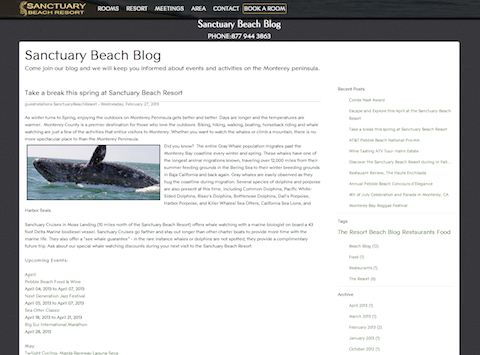
Your blog is a great avenue for both reminding potential customers why that moment is a great time to travel, and for pitching them on deals relevant to whatever event or season might be happening. You can send these articles to your email list, as well as optimize them with keywords that have high search traffic. This latter strategy can drive more organic traffic to your website. For example, “SXSW hotels” receives 170 searches per month, so Austin-area hotels could write blogs optimized for that keyword so they rank when people search for that term in Google. Here’s an example of a blog post advertising Spring time events in the area around The Sanctuary Beach Resort in Monterey Bay:

Hook Viewers with Strategic Design
Often, travelers shopping on OTAs visit the hotel’s website to learn more about the accommodations offered. This is your chance to capture those site visitors and stop them from going back to the OTA. This takes smart web design.

First off, make it as clear and hassle-free as possible to book. Provide “book now” buttons on every page that link to your hotel booking automation system. These buttons should be located at the top of the page so they are the first thing customers see. Also, include call-to-actions on every page that encourages visitors to “sign up for our email list for exclusive discounts,” or “Like on us on Facebook for special deals.”

Also, many customers assume they will get the “least desirable rooms” if they book on an OTA. So you need to show them what your best rooms look like immediately. This could convince them it’s worth splurging on your room rather than an OTA room. Make sure your most attractive rooms, views and balconies (if you have them) are front and center (like on your homepage). These images need to be professionally taken, high quality and show the best parts of your most desired rooms – soaking tubs, incredible views, large windows and so on.

By implementing these tips, savvy hotel managers can drive customers to their own website without upsetting their OTA and still reap the clear benefits of using OTAs. Rather than a battle, it can be a win for everyone involved.

Interact with Customers on Review Sites
Many times when customers use OTAs, they get a list of five or so properties in a similar price range. In addition to visiting the hotel websites, they might also go to something like Yelp or TripAdvisor. This presents another opportunity to draw customers to your own site, rather than having them go back to the OTA to book.

When customers post reviews about your hotel, you need to try your best to answer as many as possible, where they’re positive or negative. Review, a web-based tool by eRevMax, makes monitoring these reviews as easy as checking emails. The application scours all hotel review sites and collects every mention of your hotel in one location. It also lets you respond directly to guests without ever leaving its interface, cutting down time spent hopping from one review site to another for an effective hotel guest review management process.

Besides just viewing and responding to comments, the tool gives you a deeper understanding of your customers. You can see exactly what’s working and what’s not, trends among customers, and also how your hotel stacks up compared to your competitors.

How do you increase direct bookings? Let us know!


Alan S. Horowitz contributed to this report.

Ashley Verrill is an analyst with Software Advice. She has spent the last six years reporting and writing business news and strategy features. Her work has been featured or cited in Inc., Forbes, Business Insider, GigaOM, CIO.com, Yahoo News, the Upstart Business Journal, the Austin Business Journal and the North Bay Business Journal, among others. She also produces original research-based reports and video content with industry experts and thought leaders.

Bourbon Hotels & Resorts uses RateTiger for rate and inventory management

Bourbon Hotels & Resorts, one of the major hospitality players in Brazil, has signed up eRevMax to increase their online business penetration and revenue. “RateTiger will help Bourbon Hotels & Resorts have complete control over revenue management. They will be able to identify the best producing websites, while also improving the relationship with channels that have a lower commission.” said Jan Murza, VP-Sales, Americas, eRevMax International.

Online travel is growing at over 18% in Brazil, and expected to cross USD 20 billion by 2014, as the leisure tourism sector gets a huge boost from international tourists visiting the country for the FIFA World Cup. Ten properties will be using RateTiger Channel Manager to increase online sales by ensuring real-time room availability across all distribution points through automatic adjustment from pooled inventory.


Read the full story here

The Curious Case of Guest Reviews

Being a part of the industry, hotel reviews are something I always take with a pinch of salt, especially those making extremely negative remarks in online reputation sites.  However, the internet is a place for opinions and if many more people join in the chorus to say negative remarks about the property, then I would rather give it a miss than taking a chance on a booking. But does that really mean that it is a bad hotel?  

Truth be told, if more people are not happy with the property than are happy, then there must be something wrong with it. Guests express their dissatisfaction when they have bad experience. The first lesson of the service industry is that customer is the king, and in this age of hyper-activity in the internet, they rule.


As simple as coffee makers
I worked in a hotel where a decision was made to pull off all the coffee makers from the rooms.  Management decided that it would save money in the long run because they would be cutting the cost of replacing and stocking this one guest amenity and could focus time and money in other areas.  There was a café in the lobby and so at check-in, guests were given a voucher to use at the café.  You would think the problem was solved. Well, not quite!

Guests began to leave negative reviews not only on travel sites, but also through the hotel’s internal guest feedback form.  It seemed that one amenity affected their entire stay and made them question the worth of the room.  To appease the guests, rate adjustments had to be made; additionally they were provided complimentary coffee from the café.  Our ranking on TripAdvisor went down because our competitors continued to supply coffee-makers in their rooms and so guests felt they were getting more for their money.  Another decision was made by the executive team and coffee makers were placed back in the rooms so that we could recover from the guest backlash.  

Unknowingly (or maybe not) guests have placed themselves at the decision-making table of most hotels!

Stitching it together
As revenue management evolves, it is getting away from simple rate management and is now incorporating customer relations and social media into its strategy. The more satisfied guests you have, the more likely the guest is to return and spend more money, as well as telling others so they will visit and spend money as well. Hence reputation has a positive correlation with the hotel’s overall Average Daily Rate (ADR) and revenue. The time has come for the revenue management department to work hand in hand with the marketing department.

A recent survey by Laterooms.com suggests that 90% of travelers would avoid booking hotels labelled as “dirty” in online review sites. Sure, the situation might not be as bad as the guest made it seem, but the hotel cannot prevent the reviewer from expressing his/her opinion. However the beauty of online reputation sites is that most will give the hotel an option to respond. And the hotel needs to do just that – Respond! More so for negative reviews!

As an hotelier, facing these challenges can be a nightmare, especially when it hits you out of the blue. Therefore, it is essential to take an analytical approach to understand your strengths and weaknesses as per your guests and take a cohesive approach to address these issues. However since guests share feedback on various review and travel sites – all this valuable information lay scattered and unstructured. It is here that online reputation management tools play a big role in consolidating these guest reviews and provide them to hotels in structured reports. Usually, these tools pull guest feedback from various review websites including Qype, Holidaycheck, Yelp, Expedia, Facebook, Twitter etc. 
Data is then compiled together into review reports which include guest details (as it appears on the site) along with their feedback and the rating they provide to the hotel. eRevMax, the company I worked for has its reputation management tool – RateTiger Review, which uses sentiment analysis to understand the guest’s emotion towards various aspects of the property. Keywords relevant to the properties are then identified, and ranked based on their popularity, frequency of mentions, and guests’ sentiments towards that category.

In other words, semantic analysis gives out a snapshot of what’s right and what’s wrong with
the property. For the hotel, it serves as a measurement of guests’ perception against intended brand positioning. For the marketing team this analysis provides a key insight into guests’ preference, which will help them customize their promotions to have a direct resonance with customer sentiment. From the operational perspective, you now know the areas you need to address the most. For instance, if a hotel continuously keeps getting comments that their rooms are outdated and uncomfortable; this is an indication to the management to invest in renovation to ensure guest satisfaction, as well as attract new guests.  Guest review analysis works hand in hand with rate, occupancy, RevPAR and channel performance to provide hotels with the overall picture, and efficiently use Price Quality metrics to make strategic rate decisions.


Managing your feedback
The explosion of social media has made it almost impossible for hotels to ignore online reputation. According to recent studies, one third of consumers will not book a hotel room without first reading reviews first (Laterooms Survey, Nov 2012). Reviews with a rating on 4 – 5 generate more than double the conversion compared to a review with 1.0 – 2.9 rating on Expedia. Hotels that have a higher guest score typically will have better placement on the travel sites.  A better placement on the travel site means more bookings.  More bookings mean a higher room rate, and eventually higher revenue for the hotel.  


Take the example of Slovenia based LifeClass Hotels & Spa, which has experienced a surge in repeat business by developing a post-stay, guest engagement through online guest review websites. Each property assesses the information and responds to guest reviews from social channels like Facebook, Yelp, etc along with those associated with sales channels (like Booking and Expedia) multiple times a day. “We have been actively monitoring guest reviews of our properties as well as those of our competitors. RateTiger Review has helped us to respond pro-actively to negative reviews, and address our product offerings,” observed Alen Milosevic. This has resulted in 30% revenue growth in 2012.

What’s more, an improved ranking has a positive correlation with direct booking. For 4C Hotels in London, pro-active guest engagement has resulted in a 5% increase in direct booking. “Whenever we see a negative posting, we action a proper investigation to find out what went wrong. We don’t make the same mistakes as before, we are able to identify them and address them,” says Asad Zaheruddin, General Manager at the hotel.

A strong visible position on guest review websites indicate that your Price Quality Index is working well, that will enable you to make the right pricing decisions based on RevPAR performance.  This will allow the hotel to flex their rates based on a number of pricing strategies depending on booking levels. However, there are no short cuts. It is an evolving process that has to start today! As we move towards the age of consumer controlled brand conversations, hotels need to integrate customer feedback into their business approach and strategy planning.

Revenue management was always a game of chess and now even more pieces are being added to the board. By staying actively engaged with guests, hotels can ensure a more consistent and loyal base. Are you listening?


Authored by Rose Adegite, ex-Revenue Manager; adapted by Aparna Bhattacharya, PR Lead at eRevMax.